CRPS stands for Common Redundant Power Supply. It is mainly used in servers, storage systems, switches, AI servers, and industrial computing equipment to standardize the form factor, card-edge connector, management signals, and firmware behavior of hot-plug redundant power supply modules.
Compared with a common ATX power supply, CRPS has several clear characteristics:
- Modular hot-plug design, suitable for
1+1,2+1, andN+1redundancy. - The main output is usually a single
12Vrail, and the motherboard or PDB converts it to the voltages required by CPUs, memory, drives, and fans. - It uses a 2x25 card-edge connector, commonly 50 pins.
- It supports
PMBus / SMBus / I2Cmanagement for reading voltage, current, temperature, alarms, and FRU information. - It supports server PSU features such as current sharing, remote sense, PSON power-on control, and PWOK status output.
Early CRPS designs were mainly promoted by Intel. Later, the form factor evolved into OCP M-CRPS, or Modular Hardware System - Common Redundant Power Supply. Today many vendors use terms such as CRPS, M-CRPS, Intel standard CRPS form factor, or OCP M-CRPS in their documentation. In actual use, pay attention to the details: two supplies both called CRPS may still differ in power rating, length, width, airflow direction, firmware, and available signals.
CRPS vs CSPS
The previous article covered CSPS / Common Slot, which is commonly seen in the earlier HP / HPE server ecosystem and typically uses a 64 pin card-edge connector. CRPS is closer to the Intel / OCP ecosystem, and its typical connector is 2x25, or 50 pins total.
A simple comparison:
| Item | CSPS / Common Slot | CRPS / M-CRPS |
|---|---|---|
| Common ecosystem | HP / HPE Common Slot | Intel CRPS, OCP M-CRPS, multi-vendor servers |
| Common connector | 64 pin card edge | 2x25 card edge, 50 pins |
| Main output | 12V | 12V |
| Management interface | PMBus / SMBus | PMBus / SMBus |
| Interchangeability | More vendor-ecosystem oriented | More focused on cross-platform standardization |
| Notes | Different HP generations may still differ | CRPS and M-CRPS still require size and signal verification |
So CRPS and CSPS should not be mixed casually. They may both be hot-plug 12V server power supplies, but their gold-finger count, mechanical structure, and signal definitions are different.
Standard 2x25 Edge Connector Pinout
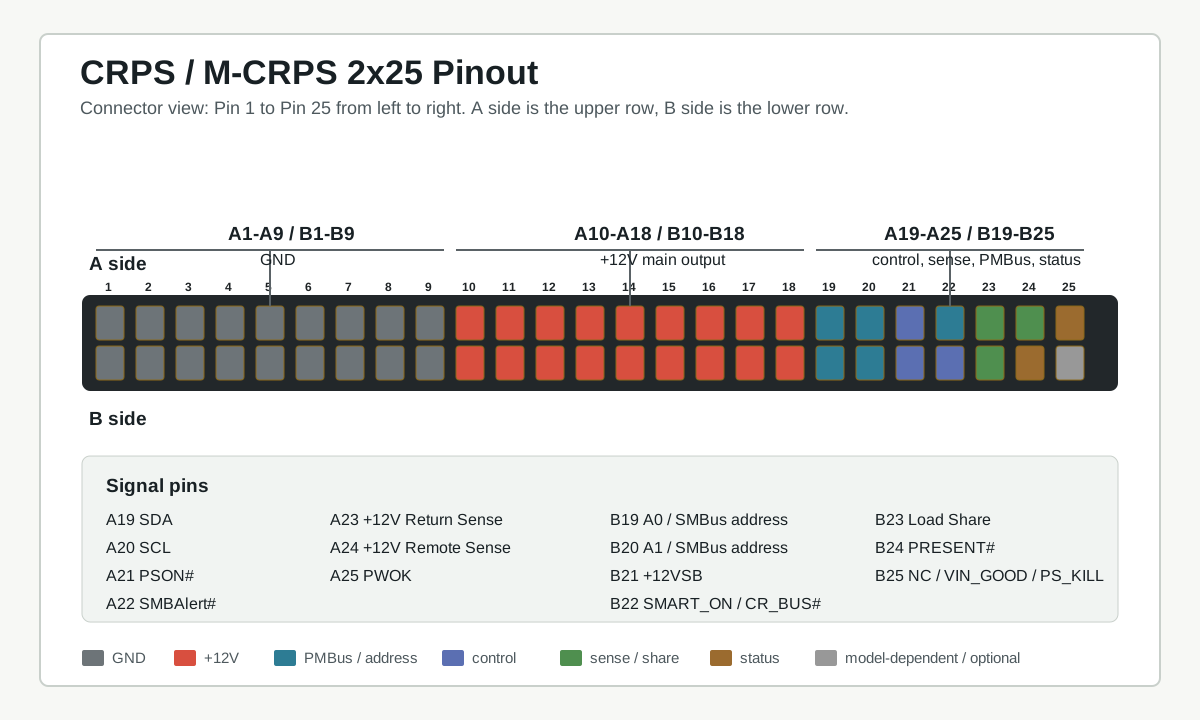
The following is a common 2x25 CRPS pinout seen in many PSU documents. Different vendors may rename some signals as SMART_ON, CR_BUS#, PS_KILL, VIN_GOOD, and so on, but the general structure is usually similar.
| Pin | A-side definition | B-side definition |
|---|---|---|
| 1 | GND |
GND |
| 2 | GND |
GND |
| 3 | GND |
GND |
| 4 | GND |
GND |
| 5 | GND |
GND |
| 6 | GND |
GND |
| 7 | GND |
GND |
| 8 | GND |
GND |
| 9 | GND |
GND |
| 10 | +12V |
+12V |
| 11 | +12V |
+12V |
| 12 | +12V |
+12V |
| 13 | +12V |
+12V |
| 14 | +12V |
+12V |
| 15 | +12V |
+12V |
| 16 | +12V |
+12V |
| 17 | +12V |
+12V |
| 18 | +12V |
+12V |
| 19 | PMBus_SDA |
A0 / SMBus address bit |
| 20 | PMBus_SCL |
A1 / SMBus address bit |
| 21 | PSON# |
+12VSB |
| 22 | SMBAlert# |
SMART_ON / CR_BUS# |
| 23 | +12V_Return Sense |
+12V_Share Bus# / Load Share |
| 24 | +12V_Remote Sense |
PRESENT# |
| 25 | PWOK |
NC / VIN_GOOD / PS_KILL optional |
A1-A9 and B1-B9 are ground. A10-A18 and B10-B18 are the main 12V output. In other words, the high-current main output has 18 contacts for 12V and 18 contacts for GND. The remaining A19-A25 and B19-B25 pins are used for management, control, sense, and status signals.
Pin Function Notes
High-Current Output
+12V is the main output and is usually present after the supply is enabled. CRPS power ratings commonly range from 550W, 800W, and 1300W to 1600W, 2000W, 2400W, 3000W, or even 3200W.
At 12V, that roughly means:
- 800W is about 66.7A.
- 1300W is about 108A.
- 1600W is about 133A.
- 2400W is about 200A.
- 3200W is about 267A.
This level of current cannot be carried by only a few contacts or thin wires. When designing a PDB or breakout board, all +12V and GND contacts should participate in current sharing, with large copper pours, copper bars, heavy-copper PCBs, or multilayer parallel structures.
+12VSB
+12VSB is the standby 12V output. As long as input power is present, it is usually available even before the main 12V output is enabled. It powers the BMC, management controller, power-on control circuit, PMBus pull-up resistors, or standby logic.
Do not treat +12VSB as the main output. Its current capability is usually much lower than the main 12V rail. Common values include 1A, 2A, and 2.5A, but the exact value depends on the PSU documentation.
PSON#
PSON# is the main output power-on control pin and is active low. A common method is to pull PSON# to ground through an open-drain output, MOSFET, or transistor, causing the PSU to enter the working state and enable the main 12V output.
For temporary testing, you can pull PSON# down to GND through a resistor, for example in the 1kΩ to 10kΩ range for a lower-risk first test. Do not immediately hard-short unfamiliar signal pins.
PWOK
PWOK is the Power OK status signal. After the main 12V output becomes stable, the PSU uses this signal to tell the system that the output is valid. The motherboard or PDB can use it as a power-sequencing condition.
If PSON# is already pulled low but PWOK does not change, check input voltage, load, protection state, PRESENT#, remote sense, and PMBus alarms.
PMBus_SDA / PMBus_SCL
These two pins are the PMBus / SMBus management bus, used to read or control PSU status. Common uses include:
- Reading output voltage, current, and input power.
- Reading temperature, fan speed, alarms, and fault status.
- Reading vendor, model, serial number, and FRU information.
- Working with the BMC for power capping, alarm logging, and redundancy policies.
Although PMBus is based on SMBus / I2C, its command set, address, and electrical levels must follow the specific PSU documentation. Do not assume it can be connected directly to a 5V I2C bus.
A0 / A1
A0 and A1 are commonly used to set the SMBus address. In a redundant multi-PSU system, each PSU module needs a different address so the BMC can identify PSU1, PSU2, PSU3, and so on.
Many power supplies have internal pull-ups on the address pins. The PDB pulls them low or leaves them floating according to the slot position, which determines the address combination.
SMBAlert#
SMBAlert# is the SMBus alert signal and is usually active low. When a temperature, input, output, fan, or protection-related event occurs, the PSU can use this signal to ask the BMC to read PMBus status.
SMART_ON / CR_BUS#
This signal is not named consistently across documents. Common names include SMART_ON, CR_BUS#, and Wake up Bus. It is related to redundancy, PSU sleep, and cold redundancy.
At low load, the system can let some redundant power supplies enter a lower-power state while only the necessary supplies carry the load. When load increases or one PSU becomes abnormal, the system wakes the other modules. This type of feature usually requires coordination among the PDB, BMC, and PSU firmware, so it is not recommended to drive it casually on a simple DIY breakout board.
+12V Remote Sense / +12V Return Sense
These two pins are remote sense lines, used to compensate for cable and copper loss between the PSU and the load.
+12V Remote Senseconnects to the 12V sense point at the load end.+12V Return Senseconnects to the ground / return sense point at the load end.
If the PSU requires remote sense and the breakout board does not handle it correctly, the output voltage may be inaccurate, or the supply may enter protection or fail to start. A simple breakout board usually ties the sense lines to local 12V / GND according to the documentation, but avoid creating a wrong path where a thin sense wire carries high current.
+12V Share Bus#
+12V Share Bus#, or Load Share, is the parallel current-sharing signal. When multiple CRPS modules are paralleled, the supplies coordinate current sharing through this signal so that one module does not carry too much load for a long time.
For single-PSU use, this signal usually does not need to be involved in main output testing. For multi-PSU parallel operation, it must be handled according to the PSU and PDB documentation. Do not simply hard-parallel the 12V outputs and run them at full load.
PRESENT#
PRESENT# is the PSU presence-detect signal and is usually active low. The PDB or motherboard uses it to determine whether a PSU module is inserted in the slot.
Some power supplies may need PRESENT# to be handled correctly before entering the expected working state. When testing an unfamiliar CRPS module, first confirm the default level of PRESENT# and whether it needs to be tied to ground.
VIN_GOOD / PS_KILL / NC
B25 varies across documents. Some mark it as NC, some use it as VIN_GOOD, and some mention optional PS_KILL. Therefore this pin should not be wired based on experience from only one model.
For a generic breakout board, it is better to bring B25 out separately and leave a test point. Do not connect it to ground or 12V by default.
Basic Approach to Starting a CRPS PSU
For standalone testing, the following sequence reduces risk:
- Do not connect the main load. Apply only AC input and check whether
+12VSBis present. - Confirm the A/B side orientation and identify
GND,PSON#,PRESENT#, andPWOK. - Pull
PSON#down toGNDthrough a resistor and check whether the main+12Voutput appears. - Add a small load, such as a 12V bulb, resistor load, or electronic load.
- Increase the load gradually while watching output voltage, fan behavior, temperature rise, and protection behavior.
- If monitoring is needed, connect PMBus after confirming voltage levels, address, and pull-ups.
If the PSU shuts down a few seconds after starting, common causes include:
- No minimum load.
- Incorrect handling of
PRESENT#or remote sense. - Insufficient input voltage, with power derating at low-line input.
- Fan, temperature, overcurrent, or overvoltage protection.
- PMBus / BMC expected status signals are not satisfied.
Breakout Board Design Notes
A CRPS breakout board may look like it is just bringing out 12V, but the real difficulty is high current and reliability.
Recommendations:
- Use a card-edge connector with the proper current rating, such as the common 2x25 CRPS connector seen in datasheets.
- Use large copper pours, heavy copper, multilayer parallel planes, copper bars, or stud outputs for
+12VandGND. - Make every high-current contact participate in current sharing. Do not connect only a few pins.
- Handle sense lines separately and keep them away from the main current path.
- Control
PSON#with an open-drain output or MOSFET. Do not let an MCU hard-pull an unknown signal directly. - Keep ground reference and test points near
PMBus_SDA/PMBus_SCL. - Add fuses, breakers, TVS devices, or electronic protection on the output. At minimum, have a clear short-circuit protection strategy.
- High-power modules require proper airflow. Do not let a server PSU run at full load for a long time in a small box with no airflow.
Common CRPS / M-CRPS Models and Series
The following table lists common CRPS / M-CRPS models, series, and power ranges found in documentation. When buying used modules, still check the nameplate, connector, length, airflow direction, and PDB compatibility.
| Vendor / Series | Common models / power | Notes |
|---|---|---|
| Intel CRPS | FXX460GCRPS, FXX750PCRPS, FXX1200PCRPS, FXX1600PCRPS |
Common CRPS options for Intel server platforms, covering 460W, 750W, 1200W, and 1600W |
| Bel Power Solutions | PEC800-12-074xA, TEC800, TEC1300, TEC1600, TEC2000 |
Common CRPS front-end supplies; documentation clearly provides a 2x25 pinout |
| Advanced Energy / Artesyn | CSU1300AP, CSU1800AP, etc. |
Data-center / server PSU modules, commonly 1300W and 1800W |
| Lite-On | RPG800-12AS, RPG1300-12AS, 1600W CRPS series |
Lite-On CRPS product line for data centers, cloud computing, and AI servers |
| FSP | FSP1600-20HM, FSP2400-22HM, FSP550-20FM, FSP800-20FM, FSP2000-20FM, FSP2400-20FM |
FSP CRPS / M-CRPS modules, commonly 550W to 2400W |
| Compuware | CPR-8011-3M1, MCRPS 1200W / 1600W / 2200W / 3200W |
Supports PMBus, redundancy, and current sharing; MCRPS targets AI and OCP data centers |
| MORNSUN | LMS800-P12BG, LMS1600-P12B, LMS2000-P12B |
Chinese CRPS modules; documentation lists the 2x25 edge connector pinout |
| Delta | DPS-1200AB-4D and other CRPS modules |
Delta has many server PSUs; verify whether the unit is really a CRPS 50 pin form factor before buying |
| HPE M-CRPS | P73190-B21 800W, P67240-B21 1000W, P67244-B21 1500W, P67252-B21 2400W, P67248-B21 3200W |
Gen12 platform M-CRPS; HPE explicitly marks them as OCP-compliant. There are also -48VDC models P82412-B21 and P73210-B21 |
| Generic white-label / industrial brands | 550W, 800W, 1200W, 1300W, 1600W, 2000W, 2400W, 2600W, 3000W | Many products are labeled CRPS, but verify whether they really use the standard 2x25 connector |
How to Judge Compatibility Before Buying or Reusing
When you get a hot-plug server PSU, do not rely only on its appearance or on a seller title that says CRPS. Check the following:
- Whether the card edge is 2x25, 50 pins total.
- Whether A1-A9 / B1-B9 are GND, and A10-A18 / B10-B18 are 12V.
- Whether A19-A25 / B19-B25 match the PMBus, PSON, 12VSB, Sense, PRESENT, and PWOK signal layout.
- Whether the PSU can deliver its rated power at your input voltage. Many high-power CRPS supplies derate at 100-127V low-line input.
- Whether it needs a PDB, BMC, or PMBus command to enter the full operating mode.
- Whether the airflow direction fits your chassis.
- Whether it supports the redundancy mode you need, such as
1+1,N+1, cold redundancy, or current sharing.
Summary
The core points of CRPS are:
- It is a standardized redundant server PSU module.
- The typical connector is a 2x25, 50 pin card edge.
- The main output is high-current 12V, with a separate 12VSB standby supply.
PSON#controls the main output, andPWOKindicates valid output.PMBusprovides monitoring and management.- Sense and Share Bus make it suitable for high-current, redundant, and parallel operation.
If you only want a lab 12V supply, at minimum you need to understand GND, +12V, +12VSB, PSON#, PRESENT#, and PWOK. If you want a truly reliable PDB or multi-PSU parallel system, you must also handle remote sense, current sharing, PMBus, airflow, and protection carefully.
References
- Open Compute Project M-CRPS Version 1.00 Release Candidate 4
- Open Compute Project M-CRPS Version 0.70
- Bel Power Solutions PEC800-12-074xA Datasheet
- MORNSUN LMS2000-P12B CRPS Datasheet
- Compuware CPR-2021-2HK CRPS Power Distribution Board
- HPE Modular Common Redundant Power Supplies QuickSpecs
- Lite-On CRPS Product Line
- Bel TEC800/1300/2000 CRPS Front-End Power Supplies