Modern discrete graphics cards usually cannot rely only on the PCI-E slot for power. Higher-end GPUs need extra power from PCI-E auxiliary connectors, most commonly 6-pin and 6+2-pin connectors.
Why Extra Power Is Needed
The PCI-E slot itself can provide limited power. When a GPU needs more power than the slot can safely provide, the graphics card uses external PCI-E power connectors from the power supply.
The common connector types are:
- PCI-E 6-pin;
- PCI-E 6+2-pin, which can be used as either 6-pin or 8-pin.
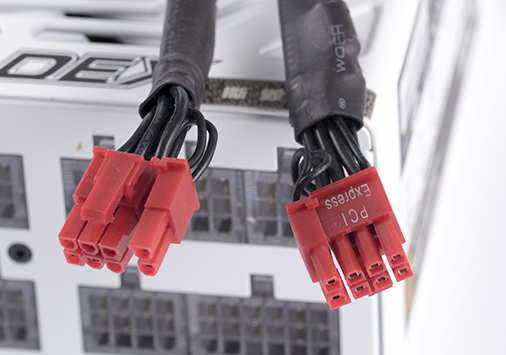
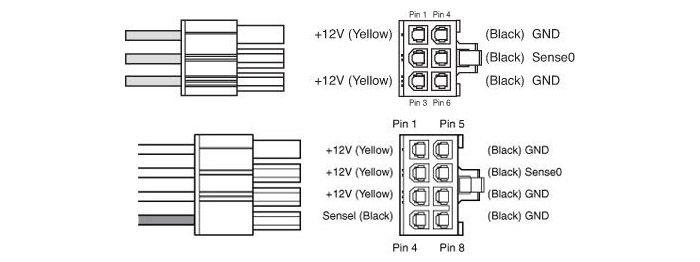
6-Pin And 6+2-Pin
A 6+2-pin connector is essentially an 8-pin connector split into 6 pins plus 2 additional pins. The split design improves compatibility, allowing the same cable to work with cards that need either 6-pin or 8-pin input.
The difference is not about performance by itself. It is mainly about compatibility and power capacity.
Power Capacity
PCI-E auxiliary connectors mainly provide 12V power.
In physical wiring terms, a 6-pin connector has fewer 12V and ground lines than an 8-pin connector. A 6+2-pin or 8-pin connector can carry more current.
However, connector physical capacity and PCI-E specification limits are not the same thing. In the PCI-E specification, a 6-pin connector is usually rated for up to 75W, while an 8-pin connector is usually rated for up to 150W.
Practical Advice
When connecting GPU power:
- use dedicated PCI-E power cables from the PSU;
- avoid mixing modular PSU cables from different brands;
- do not overload one cable with too many adapters;
- check the GPU vendor’s recommended PSU wattage;
- make sure the connector is fully inserted.
Loose or overloaded GPU power connectors can cause crashes, overheating or connector damage.
Summary
PCI-E 6-pin and 6+2-pin connectors provide additional 12V power for graphics cards. The 6+2-pin design improves compatibility with both 6-pin and 8-pin GPU sockets. Always follow the GPU and PSU documentation when wiring high-power graphics cards.